Muse Glimmer is Meta’s 30-billion-parameter causal language model with a dedicated perception encoder, distilled from Muse Spark and published for autonomous agentic workloads on consumer and workstation hardware. Distributed via Ollama under Apache 2.0, it targets reliable tool use, long-horizon tasks, multimodal understanding, and failure recovery — without requiring cloud inference. This Workstation technical brief rewrites and expands the public model card for engineers shipping local agents.
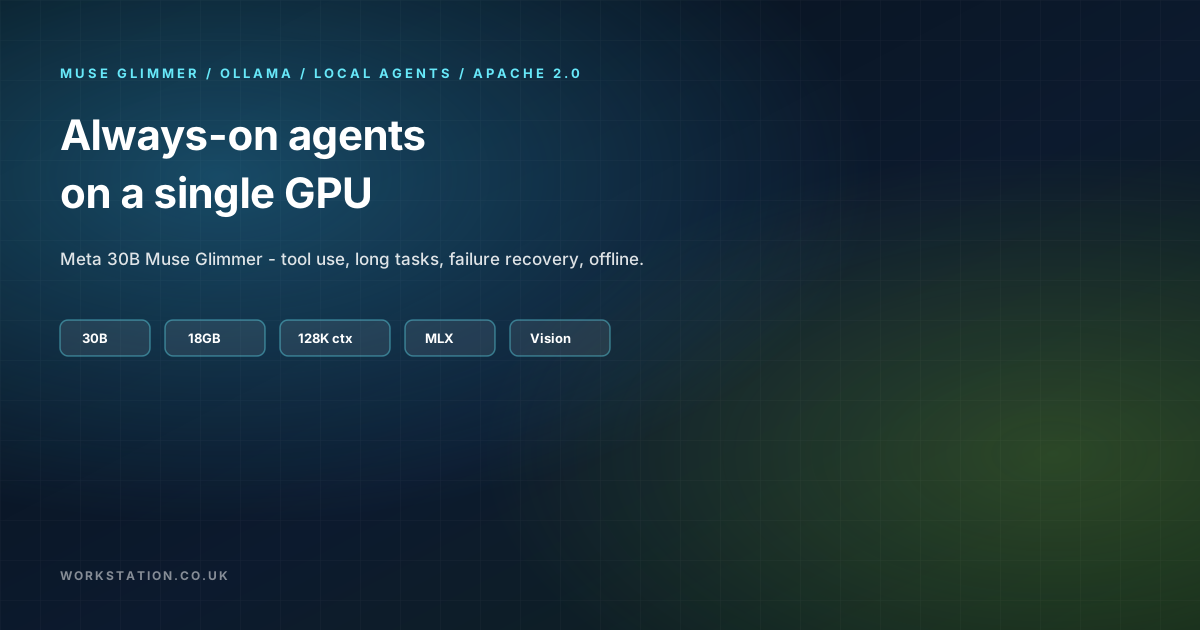
- Class: 30B causal LM + perception encoder; distilled from Muse Spark; vision + tools + thinking.
- Serve:
ollama run muse-glimmer(~18GB, 128K, text+image); Apple Silicon:muse-glimmer:30b-mlx(~21GB, DFlash). - Fit: always-on local / air-gapped agents on one GPU or Mac Silicon — not a multi-TB MoE cluster model.
- Strength signal: leads Meta’s reported size-class matrix on MCP-Atlas, DeepSearch QA, WildClawBench, SWE-Bench Pro, AA-LCR, Beam128K (high reasoning).
- Ops: scaffold via
ollama launch(Claude Code, OpenCode, Hermes, OpenClaw); govern with evals, HITL, MCP auth.
Primary sources: Ollama library — muse-glimmer; Meta evaluation methodology — Muse Glimmer methodology. Numbers and tags change; verify the live model card before procurement.
1. Architecture and design intent
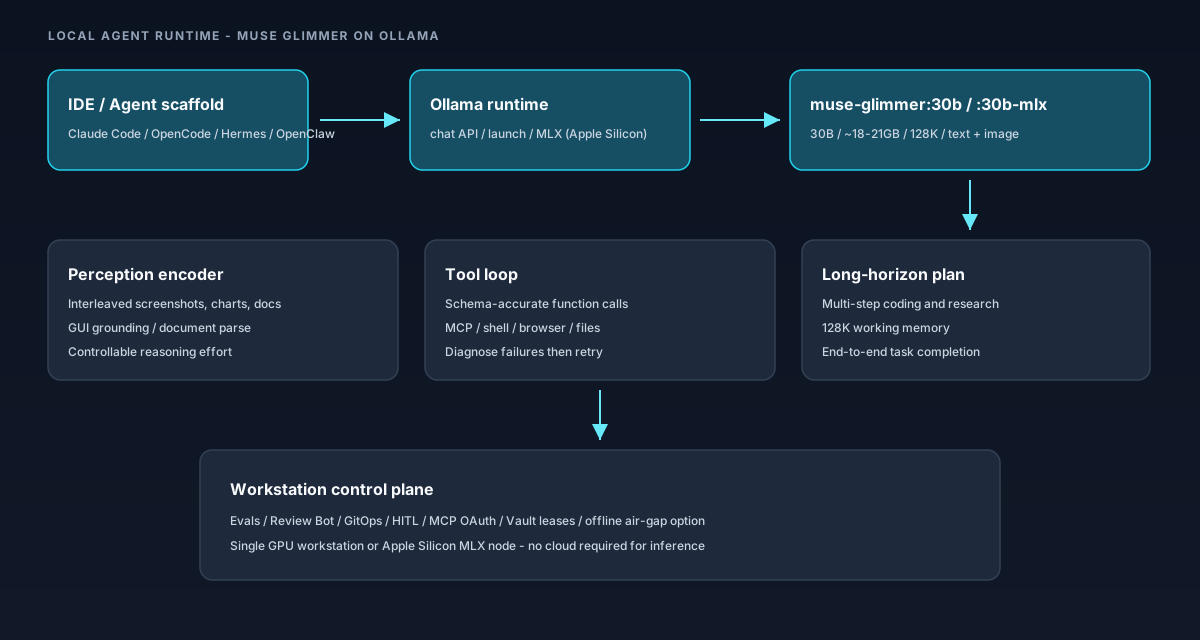
Muse Glimmer is not positioned as a general chat MoE. Meta’s framing is end-to-end agentic task completion on hardware you can buy for a desk or a small lab rack:
- Causal LM backbone (30B) — next-token generation with multi-step reasoning chains sustained across long workflows.
- Dedicated perception encoder — accepts interleaved text and images so agents can reason over screenshots, charts, and documents in the same context window as tool transcripts.
- Distillation from Muse Spark — capability transfer into a footprint that targets single-GPU / consumer-class deployment rather than datacenter-only serving.
- Failure recovery behaviour — when a tool call fails or returns an unexpected payload, the model is trained/tuned to diagnose and retry rather than halt the episode.
- Controllable effort — reasoning strength is selectable so operators can trade latency for quality per route.
- Multilingual training coverage — Meta states training data from more than 100 languages.
For Workstation stacks, the product implication is: treat Glimmer as an agent runtime brain behind MCP tools, shells, browsers, and file editors — not as a drop-in replacement for every closed frontier API call.
2. Ollama distribution (tags, footprint, I/O)
As published on the Ollama library card (verify live sizes):
| Tag | Approx. size | Context | Input | Notes |
|---|---|---|---|---|
muse-glimmer:latest / :30b | ~18GB | 128K | Text, Image | Default single-GPU path |
muse-glimmer:30b-mlx | ~21GB | 128K | Text, Image | Ollama MLX engine; DFlash + image on Apple Silicon |
# Pull + interactive
ollama run muse-glimmer

# Apple Silicon (MLX)
ollama run muse-glimmer:30b-mlx

# HTTP chat (localhost Ollama)
curl http://localhost:11434/api/chat \
  -d '{"model":"muse-glimmer","messages":[{"role":"user","content":"Hello!"}]}'

# Scaffold launchers (from Ollama applications list)
ollama launch claude --model muse-glimmer
ollama launch opencode --model muse-glimmer
ollama launch hermes --model muse-glimmer
ollama launch openclaw --model muse-glimmer
Python / JS clients should pin the tag you validated (muse-glimmer vs :30b-mlx) in config, not hard-code latest in production agents.
3. Capability surface (engineering reading)
- End-to-end agentic completion — Meta cites strong results on DeepSearch QA, MCP-Atlas, τ3-Bench (banking), and SWE-Bench family tasks that measure scaffolded multi-turn success, not single-shot trivia.
- Reliable tool use — wide function-call coverage with schema precision across extended workflows (critical for MCP tool fleets).
- Multi-step reasoning — plan coherence over long horizons; pairs with the 128K context window for transcript + document retention.
- Failure recovery — diagnose unexpected tool results and retry; reduces “brittle agent” aborts in overnight jobs.
- Multimodal reasoning — perception encoder enables screenshot/chart/document interleaved with text (GUI grounding and doc parse benches included in Meta’s matrix).
- Scaffold compatibility — OpenClaw, Hermes Agent, and similar orchestration patterns; Ollama lists Claude Code and OpenCode launchers as first-class apps.
4. Benchmark matrix (Meta-reported, high reasoning)
Meta compares Muse Glimmer-30B (high reasoning) against Gemma4-31B and Qwen3.6-27B in thinking mode. Headline Workstation reading: Glimmer leads several agentic public suites (MCP-Atlas, DeepSearch QA, WildClawBench, Gaia2, SWE-Bench Pro) while trailing or tying peers on some desktop-agent and GDP-val metrics. Always re-run on your harness.
| Category | Benchmark | Glimmer-30B | Gemma4-31B | Qwen3.6-27B |
|---|---|---|---|---|
| General agentic | MCP-Atlas (Public) | 75.5 | 54.2 | 62.5 |
| DeepSearch QA | 74.6 | 61.7 | 71.1 | |
| τ3-Banking | 23.5 | 15.1 | 16.7 | |
| WildClawBench | 47.6 | 37.6 | 43.2 | |
| GDPVal-AA v2 | 953 | 811 | 1141 | |
| Gaia2 | 43.3 | 36.4 | 40.0 | |
| SkillsBench (w/ skills) | 44.3 | 32.4 | 46.6 | |
| OSWorld-Verified | 65.9 | 58.5 | 75.6 | |
| Agentic coding | SWE-Bench Pro | 51.2 | 36.9 | 50.2 |
| SWE-Bench Verified | 76.0 | 66.6 | 77.2 | |
| TerminalBench 2.1 | 51.7 | 43.4 | 60.7 | |
| SciCode | 43.6 | 43.4 | 39.8 | |
| Multimodal | CharXiv Reasoning | 78.8 | 77.7 | 78.4 |
| ScreenSpot Pro | 75.4 | 75.9 | 76.1 | |
| OmniDocBench v1.5 | 75.8 | 72.5 | 77.8 | |
| MMMU Pro | 74 | 73 | 75 | |
| Reasoning / LCR | IFBench | 77.0 | 76.0 | 70.8 |
| AIME 2026 | 94.7 | 89.2 | 94.1 | |
| GPQA Diamond (AA) | 83.5 | 85.7 | 84.2 | |
| HLE Text (AA) | 22.0 | 23.6 | 23.1 | |
| AA-LCR | 80.0 | 68.3 | 73.3 | |
| Beam128K | 65.1 | 58.2 | 63.0 |
Safety benches (CI Memories, Siren AgentDojo) show trade-offs: Glimmer reports high utility under AgentDojo injections with mid-pack ASR; treat safety as a deployment control problem (prompt firewalls, tool allowlists, HITL) — not a solved model property. See Meta’s methodology PDF for judge models, attempt counts, and harness caveats.
5. Evaluation methodology (what the numbers mean)
Meta’s methodology note is essential before you quote any cell in a board deck:
- Peer selection: size-class open models (Gemma4-31B, Qwen3.6-27B); peers may use self-reported or internally reproduced scores; Artificial Analysis used when available for all three.
- Sampling: Glimmer reported at high reasoning strength with temperature=1.0 / top_p=0.95 / top_k=64; peers use vendor-recommended thinking configs (Qwen uses cooler temps on some agent benches).
- Harness bias caveat: Meta notes third-party models may not be tuned to Meta’s tool/system prompts — absolute ranks can shift under peer-native scaffolds.
- MCP-Atlas: multi-turn tool use across 20+ MCP servers; LLM-judge pass rate (threshold 0.75) on 500 public tasks, averaged over 4 runs.
- DeepSearch QA: autonomous browsing loop (search/open/find) on 900 hard research questions; F1 via judge extraction.
- WildClawBench / Gaia2: long-horizon Dockerised agent tasks under OpenClaw-style harnesses with event injection and mixed deterministic/LLM grading.
- SWE-Bench: bash + file tools scaffold; Pro and Verified averaged across multiple runs — Pro comparisons avoid Qwen’s refined-task variant.
- OSWorld-Verified: GUI-only Ubuntu VM control from screenshots (no direct shell); action-space differences between models matter.
- Beam128K: non-agentic long-context memory probe at 128K — relevant if you keep large transcripts in-context without RAG.
Workstation policy: publish Meta’s matrix for orientation, then gate production on an internal golden set (your MCP tools, your repos, your latency SLO).
6. Hardware and serving reality
- Single GPU class: ~18GB weight footprint implies a modern 24GB+ consumer/pro GPU is the practical NVIDIA floor once KV cache and vision activations are considered; profile with your max context and concurrent sessions.
- Apple Silicon: prefer
:30b-mlx(~21GB) for Ollama’s MLX path with DFlash speculative decoding and native image input — Mac Studio / Mac mini Max configs are first-class SME nodes. - Not Kimi-K3-class: this is not a multi-node MoE. If you need trillion-parameter open agents, see our open-weights guide; Glimmer owns the desk-side always-on niche.
- Kubernetes: package Ollama or an OpenAI-compatible sidecar per node; keep model pulls in your private registry/cache; do not expose Ollama unbound to the internet.
7. Security and governance for always-on agents
Local weights reduce data egress but increase the blast radius of a compromised agent host. Minimum Workstation baseline:
- MCP OAuth 2.1 + short-lived secrets (Vault leases) — see agentic security article.
- Tool allowlists and network egress policies per agent identity.
- HITL gates on irreversible actions (payments, prod deploys, mass email).
- Prompt-injection monitoring on tool-returned content (Siren AgentDojo-style threat model).
- Offline / air-gap mode tested as a first-class runbook, not a hope.
8. Production checklist
- Pin Ollama tag (
30bvs30b-mlx) and record digest/hash in GitOps. - Build a 20–50 task golden suite mirroring your MCP tools and coding workflows; track pass@1 and p95 latency at each effort level.
- Wire scaffold (
ollama launch …or custom) with structured logging of tool calls and retries. - Define hybrid router: Glimmer local for private RAG/agents; cloud failover for overflow / peak IQ.
- Document VRAM/unified-memory headroom at 32K / 64K / 128K with vision on.
- Legal: Apache 2.0 review for your distribution model (usually straightforward vs restrictive open-weight licences).
- Ship Review Bot + eval gates before enabling unattended overnight agents.
Published by Workstation. Model card: ollama.com/library/muse-glimmer.